

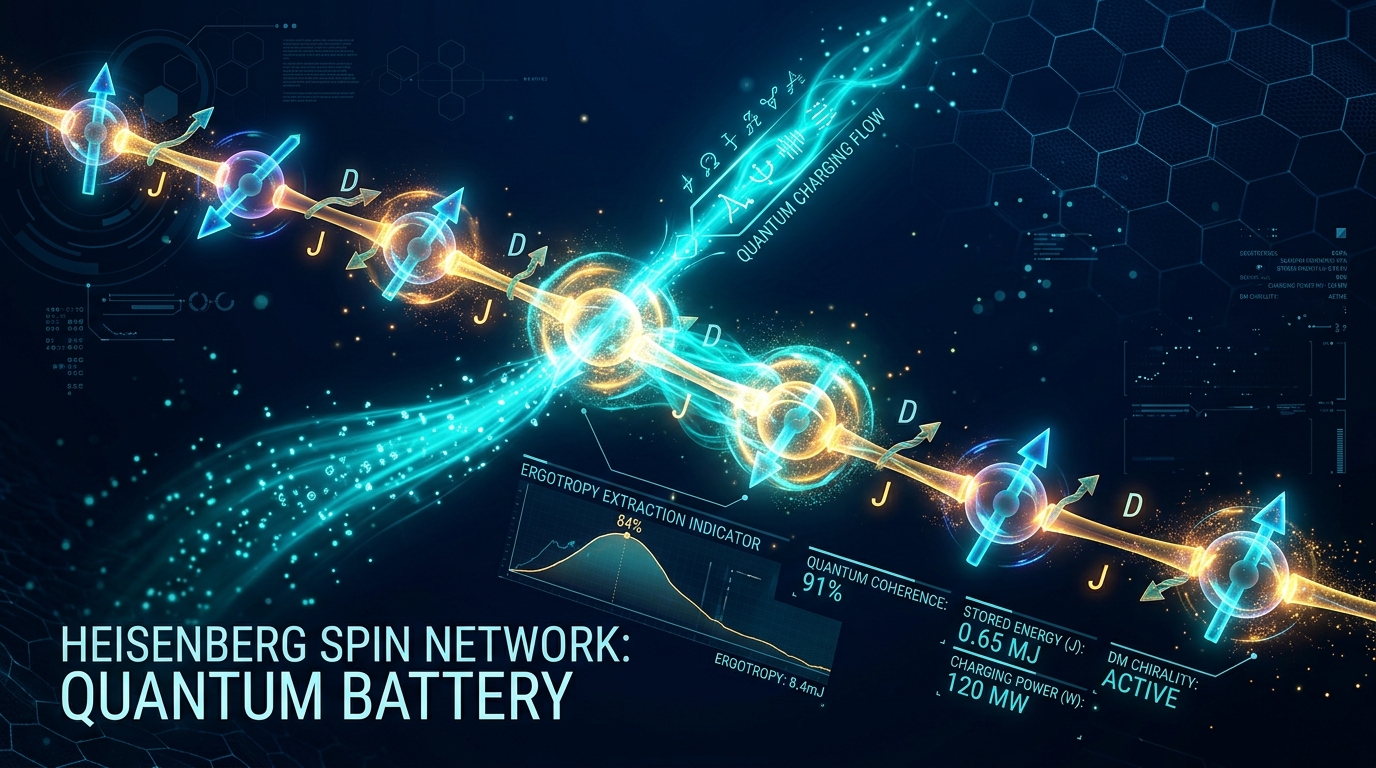
As quantum computing and quantum thermodynamics advance, researchers face a provocative question: Can the non-classical properties of quantum mechanics—such as coherence, quantum correlations, and entanglement—be utilized to store and extract thermodynamic energy faster and more efficiently than classical devices?
This is the promise of Quantum Batteries (QBs): nanoscale devices that store work in the quantum degrees of freedom of multi-body systems (such as spins, two-level atoms, or optical cavities).
In our latest study published in the New Journal of Physics (IOP Publishing), we investigate how quantum spin networks can be engineered into highly efficient quantum batteries:
Heisenberg spin networks for realizing quantum battery with the aid of Dzyaloshinskii–Moriya interaction
Suprabha Bhattacharya, Vivek Balasaheb Sabale, and Atul Kumar
New Journal of Physics 28 (1), 014508 (2026)
🔗 Read on New Journal of Physics ↗ | Google Scholar ↗
Here is an overview of the fundamental physics, the crucial role of network geometry, and how the Dzyaloshinskii–Moriya Interaction (DMI) unlocks unprecedented charging performance.
What Makes a Battery "Quantum"?
In a conventional electrochemical battery, charging $N$ identical cells in parallel requires a time that scales independently of $N$, meaning total power scales linearly: $P \propto N$.
In quantum batteries, entangling interactions during the charging process can trigger collective quantum speedups:
$$P_{\text{max}} \propto N^{\alpha}, \quad \text{with } \alpha > 1$$
This phenomenon—known as super-extensive charging or quantum supercharging—allows an entangled ensemble of quantum battery cells to charge significantly faster than if each cell were charged individually in isolation.
Stored Energy vs. Ergotropy: The Real Measure of Work
When evaluating a quantum battery, raw stored energy $E(t) = \text{Tr}[\rho(t) H_B]$ can be misleading. In quantum thermodynamics, not all stored energy is useful.
The gold standard for work extraction is Ergotropy ($\mathcal{E}$): the maximum amount of work that can be extracted from a quantum state $\rho$ via cyclic unitary operations without changing its entropy:
$$\mathcal{E}(\rho) = \text{Tr}[\rho H_B] - \min_{U \in \mathcal{U}} \text{Tr}\left[ U \rho U^\dagger H_B \right]$$
- If a state has reached a passive state (where population is monotonically decreasing with energy eigenvalues), no work can be extracted unitarily, resulting in $\mathcal{E} = 0$ even if internal energy $E > 0$.
- A high-performance quantum battery must maximize the ergotropy ratio $\mathcal{E}/E$, guaranteeing that stored energy translates into accessible, extractable work.
Designing the Battery: Heisenberg Spin Networks
In our paper, we model the quantum battery as a network of interacting spin-$1/2$ particles described by the anisotropic Heisenberg $XXZ$ model subjected to transverse magnetic fields and charging Hamiltonians:
$$H_{\text{XXZ}} = \sum_{\langle i, j \rangle} J \left( \sigma_i^x \sigma_j^x + \sigma_i^y \sigma_j^y + \Delta \sigma_i^z \sigma_j^z \right)$$
where:
- $J$ is the exchange coupling strength between spins,
- $\Delta$ is the anisotropy parameter along the $z$-axis,
- $\sigma_i^{x,y,z}$ are the standard Pauli operators for the $i$-th spin cell.
The Role of Network Geometry
The physical topology of the spin network dictates how energy flows during charging. We systematically evaluated:
- Open Spin Chains: Linear arrays with open boundary conditions.
- Closed Rings: Periodic boundary conditions facilitating circular flow.
- Supercube Configurations: Multi-dimensional hypercube topologies with dense interconnects.
- $c$-Regular Graphs & Platonic Geometries: Highly symmetric polyhedral arrangements ranging from 3 to 12 qubits, including tetrahedron, octahedron, and icosahedron geometries.
The Breakthrough: Dzyaloshinskii–Moriya Interaction (DMI)
Standard symmetric Heisenberg couplings can encounter bottlenecks: energy tends to get trapped in symmetric, decoherence-free sub-spaces or "dark states" that refuse to dump their energy into usable ergotropy.
To solve this, we introduced the Dzyaloshinskii–Moriya Interaction (DMI):
$$H_{\text{DMI}} = \sum_{\langle i, j \rangle} \vec{D}_{ij} \cdot \left( \vec{\sigma}_i \times \vec{\sigma}_j \right)$$
Arising physically from spin-orbit coupling in systems lacking spatial inversion symmetry, DMI introduces an antisymmetric, chiral exchange between neighboring spins.
Why DMI Boosts Quantum Battery Performance
- Chiral Energy Transport: The cross-product nature of DMI breaks spatial reflection symmetry, driving directed, non-reciprocal energy flow across the spin lattice and bypassing destructive interference traps.
- Enhanced Ergotropy in Supercubes: In the anisotropic $XXZ$ regime, DMI substantially enhances ergotropy—most prominently in supercube geometries—enabling nearly complete extraction of the stored energy.
- Faster Charging Cycles: By accelerating state transitions toward maximally non-passive configurations, DMI shortens charging times, yielding marked improvements in the peak charging power $P_{\text{max}}$.
- Structural Resilience: When testing across $c$-regular graphs and Platonic geometries, DMI consistently stabilizes energy storage against local parameter fluctuations.
Experimental Outlook: Bringing Quantum Batteries to the Lab
The theoretical models developed in our paper align with several cutting-edge experimental quantum architectures:
- Solid-State Molecular Magnets: Single-molecule magnets and transition metal complexes naturally exhibit significant Dzyaloshinskii–Moriya coupling due to strong spin-orbit interactions.
- Rydberg Atom Arrays: Optical tweezers allow arbitrary 2D and 3D positioning of neutral atoms (e.g., in tetrahedral or cubic geometries), enabling programmable Heisenberg and DMI-like Hamiltonians.
- Superconducting Circuit Networks: Tunable inductive couplers between transmons allow direct synthesis of non-collinear exchange couplings.
Summary & Next Horizons
| Architecture Feature | Without DMI | With DMI (Our Work) |
|---|---|---|
| Symmetry Constraints | Trapped in symmetric dark states | Broken inversion symmetry drives directional energy |
| Ergotropy Fraction ($\mathcal{E}/E$) | Moderate; significant locked passive energy | Significantly elevated, especially in supercubes |
| Optimal Geometry | Sensitive to boundary reflection | Supercube & regular graphs yield robust performance |
| Charging Power ($P_{\text{max}}$) | Constrained by isotropic dispersion | Accelerated due to chiral interaction channels |
As quantum processors continue to evolve toward on-chip nanoscale energy management, understanding the interplay between exchange interactions, chiral symmetry breaking, and geometric connectivity will be central to building sustainable quantum technologies.
For a deeper mathematical exploration of the eigenvalues, ergotropy derivations, and dynamical plots, read our full article in New Journal of Physics or visit my Google Scholar profile.