

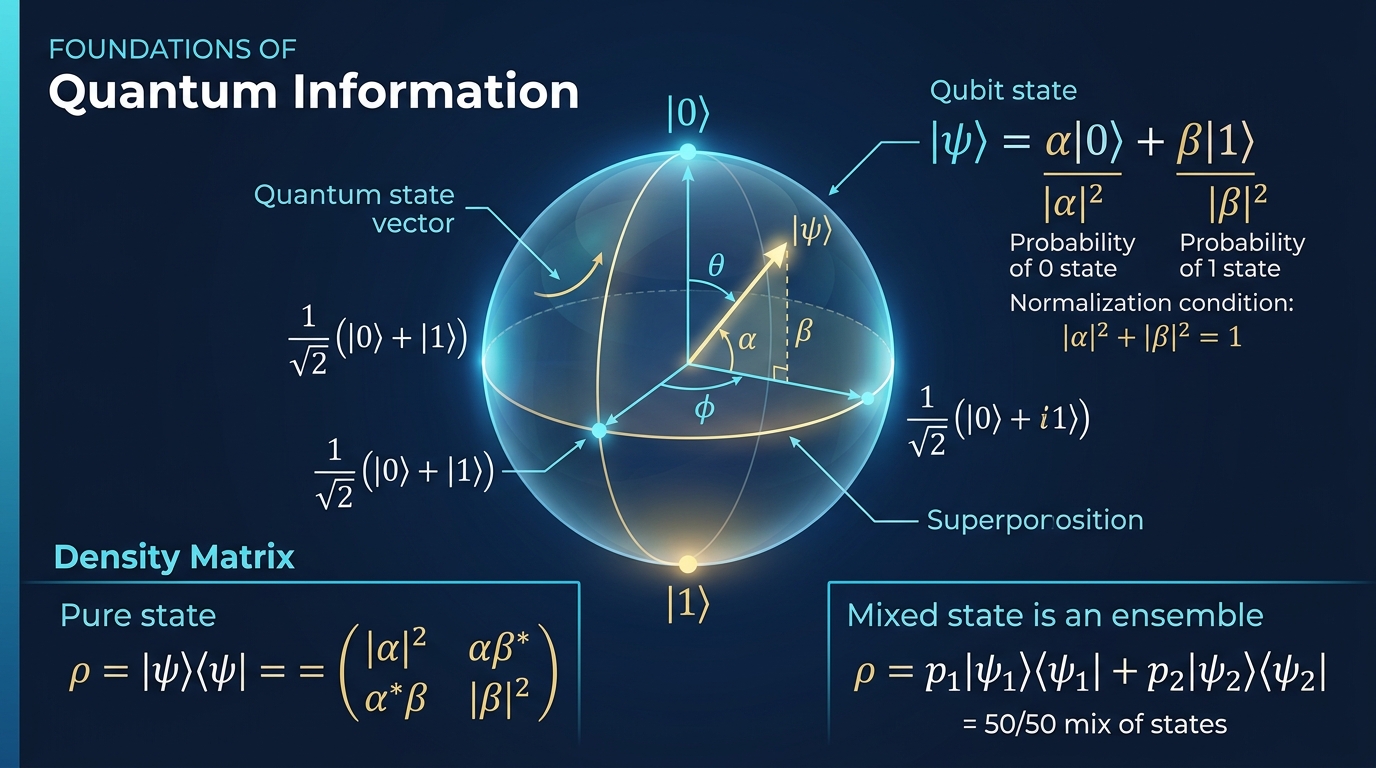
Quantum information science combines quantum mechanics with computer science and information theory. While classical computation encodes information into binary bits ($0$ or $1$), quantum systems operate in complex Hilbert spaces, unlocking phenomena like superposition, entanglement, and interference.
This article provides a pedagogical introduction to the core mathematical language of quantum information.
1. What is a Qubit?
A qubit (quantum bit) is the fundamental unit of quantum information. Unlike a classical bit, a qubit can exist in a linear combination—or superposition—of its computational basis states ${|0\rangle, |1\rangle}$:
$$|\psi\rangle = \alpha |0\rangle + \beta |1\rangle$$
where $\alpha, \beta \in \mathbb{C}$ are complex probability amplitudes satisfying the normalization constraint:
$$|\alpha|^2 + |\beta|^2 = 1$$
When a projective measurement is performed in the standard basis:
- The probability of obtaining outcome $0$ is $P(0) = |\alpha|^2$.
- The probability of obtaining outcome $1$ is $P(1) = |\beta|^2$.
2. Geometric Representation: The Bloch Sphere
Because global phase is physically unobservable ($e^{i\gamma}|\psi\rangle \sim |\psi\rangle$), any pure single-qubit state can be uniquely parameterized by two real angles $\theta \in [0, \pi]$ and $\phi \in [0, 2\pi)$:
$$|\psi\rangle = \cos\left(\frac{\theta}{2}\right) |0\rangle + e^{i\phi} \sin\left(\frac{\theta}{2}\right) |1\rangle$$
This establishes a 1-to-1 mapping between pure single-qubit states and points on the surface of a unit sphere in $\mathbb{R}^3$, known as the Bloch Sphere:
- North Pole ($\theta = 0$): $|0\rangle$
- South Pole ($\theta = \pi$): $|1\rangle$
- Equator ($\theta = \pi/2$): Superpositions such as: $$|+\rangle = \frac{|0\rangle + |1\rangle}{\sqrt{2}}, \quad |-\rangle = \frac{|0\rangle - |1\rangle}{\sqrt{2}}, \quad |+i\rangle = \frac{|0\rangle + i|1\rangle}{\sqrt{2}}$$
Any single-qubit unitary gate corresponds to a 3D rotation of the state vector on this sphere!
3. Pure States vs. Mixed States
In idealized closed quantum systems, states are described by state vectors $|\psi\rangle$ (pure states). However, in the real world:
- Systems interact with noisy environments (decoherence).
- We may only possess statistical knowledge about which quantum state was prepared.
Such states cannot be written as a single ket $|\psi\rangle$. Instead, they form a statistical ensemble:
$${\left(p_i, |\psi_i\rangle\right)}, \quad \text{where } p_i \ge 0 \text{ and } \sum_i p_i = 1$$
This leads directly to the Density Matrix Formalism.
4. The Density Operator Formalism
The density operator $\rho$ representing a quantum ensemble is defined as:
$$\rho = \sum_i p_i |\psi_i\rangle \langle \psi_i|$$
Essential Properties of Density Matrices
- Hermiticity: $\rho^\dagger = \rho$ (observable probabilities are real).
- Unit Trace: $\text{Tr}(\rho) = 1$ (total probability equals 1).
- Positive Semi-definiteness: $\rho \ge 0$ (all eigenvalues $\lambda_i \ge 0$).
Purity Criterion
To distinguish whether a quantum state $\rho$ is pure or mixed, we compute its purity $\gamma$:
$$\gamma = \text{Tr}(\rho^2)$$
- Pure state: $\text{Tr}(\rho^2) = 1$ (the state lies on the surface of the Bloch sphere, radius $r = 1$).
- Mixed state: $\text{Tr}(\rho^2) < 1$ (the state lies in the interior of the Bloch sphere, radius $r < 1$).
- Maximally mixed state: $\rho = \frac{I}{2}$ with $\text{Tr}(\rho^2) = \frac{1}{2}$ (the exact center of the sphere, $r = 0$, representing complete ignorance).
5. Connecting to Open Quantum Systems & QML
Understanding density matrices is the indispensable bridge to advanced topics in modern research:
- Open Quantum Systems: Environmental interactions transform pure states into mixed states via dynamical maps $\rho(t) = \mathcal{E}_t[\rho(0)]$.
- Quantum Machine Learning: Quantum classifiers and neural networks operate directly on density matrices to distinguish entangled from separable mixtures without requiring full quantum state tomography.
Summary Cheat-Sheet
| Concept | Pure State | Mixed State |
|---|---|---|
| Mathematical Object | State vector $ | \psi\rangle$ |
| Bloch Sphere Location | Surface ($r = 1$) | Interior ($0 \le r < 1$) |
| Purity $\text{Tr}(\rho^2)$ | Exactly $1$ | Less than $1$ (down to $1/d$) |
| Entropy $S(\rho)$ | $0$ (zero classical uncertainty) | $> 0$ (statistical mixedness) |
For more hands-on practice, check out our Quantum Computing Lab Notebooks or read our research posts on Non-Markovian Dynamics and Quantum Machine Learning.