

Who is this primer for?
Whether you are an undergraduate physics or CS student, a software developer exploring quantum computing, or a researcher from an adjacent field, this primer provides an accessible, step-by-step introduction to correlated quantum noise and why it matters for quantum hardware.
Introduction: The Independent Noise Assumption
In most introductory quantum computing courses and textbooks, noise is introduced using a convenient simplification: independent, memoryless errors.
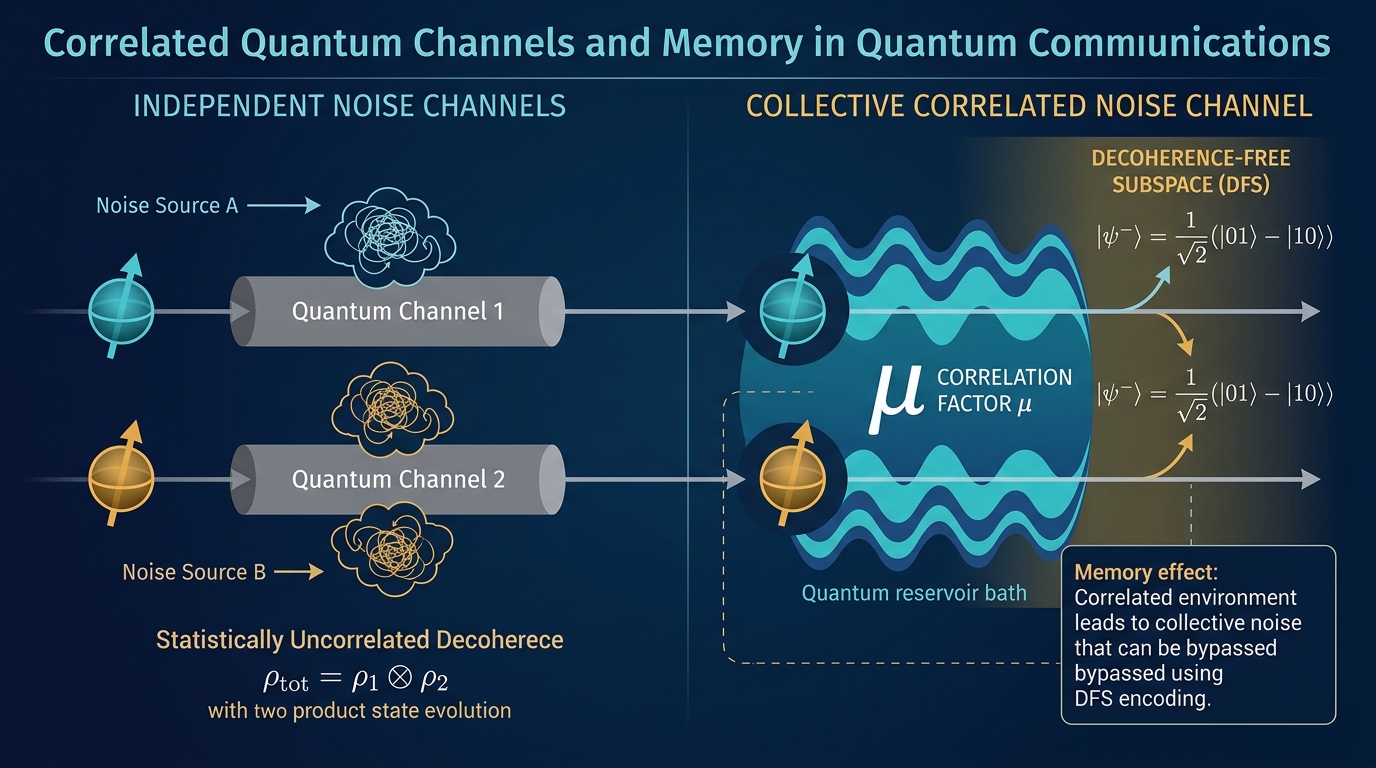
Under this standard assumption, if two qubits travel through a communication channel or sit next to each other on a chip, each qubit interacts with its own separate, isolated thermal bath:
$$\mathcal{E}_{\text{ind}}(\rho) = \left( \mathcal{E}_A \otimes \mathcal{E}_B \right)[\rho]$$
Here:
- $\rho$ is the density matrix of the two-qubit quantum state.
- $\mathcal{E}_A$ and $\mathcal{E}_B$ are independent mathematical operations (quantum channels) acting on qubit $A$ and qubit $B$ respectively.
- The symbol $\otimes$ (tensor product) signifies that the two noise processes act independently without influencing one another.
Why Real Hardware Disobeys This Assumption
In physical quantum computing hardware, qubits are never completely isolated:
- Superconducting Processors: Qubits spaced micrometers apart on a silicon wafer experience mutual inductive coupling, substrate dielectric losses, and shared stray electromagnetic radiation.
- Optical Fibers: Consecutive optical pulses (photons) traveling through long telecommunication cables pass through identical local temperature variations and fiber birefringence fluctuations.
- Trapped-Ion Chains: Ions trapped in a common potential well share collective vibrational modes (phonons), causing laser phase fluctuations to affect all ions symmetrically.
When environmental noise affects multiple qubits collectively or sequentially, we enter the realm of Correlated Quantum Channels.
💡 An Everyday Analogy
Imagine two tightrope walkers crossing a windy canyon.
- Independent Noise ($\mu = 0$): Each walker feels isolated, random air gusts that strike them at different moments. One might wobble left while the other wobbles right.
- Correlated Noise ($\mu = 1$): A massive crosswind sweeps across the entire canyon, blowing both walkers in the exact same direction at the exact same instant.
If the two walkers are holding a rigid pole between them, the shared gust doesn't twist them out of alignment—they move together! In quantum mechanics, this cooperative survival is the foundation of Decoherence-Free Subspaces.
1. The Macchiavello–Palma Model of Correlated Noise
How do theoretical physicists quantify the transition from independent noise to shared noise?
A celebrated model formulated by Chiara Macchiavello and G. Massimo Palma introduces a real correlation parameter $\mu \in [0, 1]$ that interpolates smoothly between independent and collective operations:
$$\mathcal{E}^{(2)}[\rho] = (1 - \mu) \sum_{i,j} \left(E_i \otimes E_j\right) \rho \left(E_i \otimes E_j\right)^\dagger + \mu \sum_k \left(E_k \otimes E_k\right) \rho \left(E_k \otimes E_k\right)^\dagger$$
Breaking Down the Math:
- ${E_i}$ (Kraus Operators): Mathematical operators describing the single-qubit noise process (such as bit-flips, phase-damping, or depolarizing noise) satisfying $\sum_i E_i^\dagger E_i = I$.
- $(1 - \mu)$ Term: With probability $(1 - \mu)$, independent noise operators $E_i \otimes E_j$ strike the qubits separately.
- $\mu$ Term: With probability $\mu$, identical noise operators $E_k \otimes E_k$ strike both qubits simultaneously.
Physical Interpretation of $\mu$:
| Value of $\mu$ | Channel Regime | Physical Meaning |
|---|---|---|
| $\mu = 0$ | Uncorrelated | Completely independent noise. Standard quantum error correction theorems apply. |
| $0 < \mu < 1$ | Partially Correlated | Realistic hardware setting where qubits experience both private and collective fluctuations. |
| $\mu = 1$ | Fully Correlated | Identical collective noise across the register. Unlocks passive symmetry-protected subspaces. |
2. Two Types of Memory: Environmental vs. Channel-Use
When researchers mention "quantum memory," confusion often arises because the word is used in two different contexts:
| Memory Type | Physical Origin | Key Characteristic |
|---|---|---|
| Environmental Memory (Non-Markovianity) | The bath retains quantum information and feeds it back into the system over time. | Information backflow, non-monotonic trace distance, CP-divisibility breakdown. |
| Channel-Use Memory (Correlated Noise) | Consecutive channel uses or adjacent spatial qubits experience correlated error events. | Collective operations parameterized by the correlation parameter $\mu$. |
In real open quantum systems, both mechanisms can take place at the same time. In our research paper Facets of Correlated Non-Markovian Channels, we showed that environmental non-Markovian memory and channel correlation $\mu$ can either amplify or counterbalance each other depending on the spectral properties of the bath.
3. The Silver Lining: Decoherence-Free Subspaces (DFS)
A common assumption among newcomers is that correlated noise must always be worse than independent noise. Remarkably, the opposite can be true!
When environmental noise is collective ($\mu \to 1$), the noise couples symmetrically to both qubits. Consider a collective dephasing channel where the interaction Hamiltonian is:
$$H_{\text{int}} = g \left( \sigma_z^{(1)} + \sigma_z^{(2)} \right) \otimes B_{\text{env}}$$
Now examine the maximally entangled Bell singlet state:
$$|\psi^-\rangle = \frac{|01\rangle - |10\rangle}{\sqrt{2}}$$
Let us test how the collective phase-flip operator $(\sigma_z^{(1)} + \sigma_z^{(2)})$ acts on this singlet:
$$\left(\sigma_z^{(1)} + \sigma_z^{(2)}\right) |01\rangle = (+1 - 1)|01\rangle = 0$$
$$\left(\sigma_z^{(1)} + \sigma_z^{(2)}\right) |10\rangle = (-1 + 1)|10\rangle = 0$$
Therefore:
$$\left(\sigma_z^{(1)} + \sigma_z^{(2)}\right) |\psi^-\rangle = 0$$
The Bell singlet has an eigenvalue of zero under the collective noise operator!
This means that under purely collective dephasing, the singlet state does not change at all over time. It is completely immune to the environmental noise.
This protected subspace of quantum states is called a Decoherence-Free Subspace (DFS). By encoding quantum information into DFS states, one can shield qubits passively without needing complex active syndrome measurement circuits!
4. Why Correlated Noise Matters for Quantum Error Correction
While correlated noise makes DFS encodings possible, it poses challenges for standard Quantum Error Correcting (QEC) codes:
- Independent Error Assumption: Classical and standard quantum codes (like Steane's 7-qubit code or Surface codes) are optimized on the assumption that errors occur randomly and independently with a small error rate $p$.
- Syndrome Confusion: If correlated noise causes two adjacent qubits to flip simultaneously ($X \otimes X$), a standard syndrome decoder might interpret this as a single-qubit error on a third qubit, applying an incorrect recovery operator and corrupting the logical information.
- Modern Solutions: Today's quantum computer engineers use correlated-syndrome matching algorithms, graph-based neural network decoders, and spatially aware compilation to detect and neutralize correlated hardware faults.
Summary Cheat-Sheet
| Property | Independent Channel ($\mu = 0$) | Correlated Channel ($\mu > 0$) |
|---|---|---|
| Kraus Map | Tensor product $\mathcal{E}_1 \otimes \mathcal{E}_2$ | Convex mixture of product and collective Kraus operators |
| Entanglement Dynamics | Monotonic decay or sudden death | Slower decay, freezing, or revival under collective modes |
| Error Correction | Standard stabilizer codes work optimally | Requires correlated-syndrome decoders or DFS encodings |
| Protection Strategy | Active syndrome measurements | Passive protection via Decoherence-Free Subspaces (DFS) |
Suggested Next Reads
- Research Article: Facets of Correlated Non-Markovian Channels (Annalen der Physik, 2024)
- PhD Thesis Journey: From Quantum Correlations to Their Microscopic Origin: A Journey Through Noise, Memory, and Open-System Dynamics
- Foundations Tutorial: Foundations of Quantum Information: From Qubits to Density Matrices